
Belfast, the Fleadh and the Price of Demand
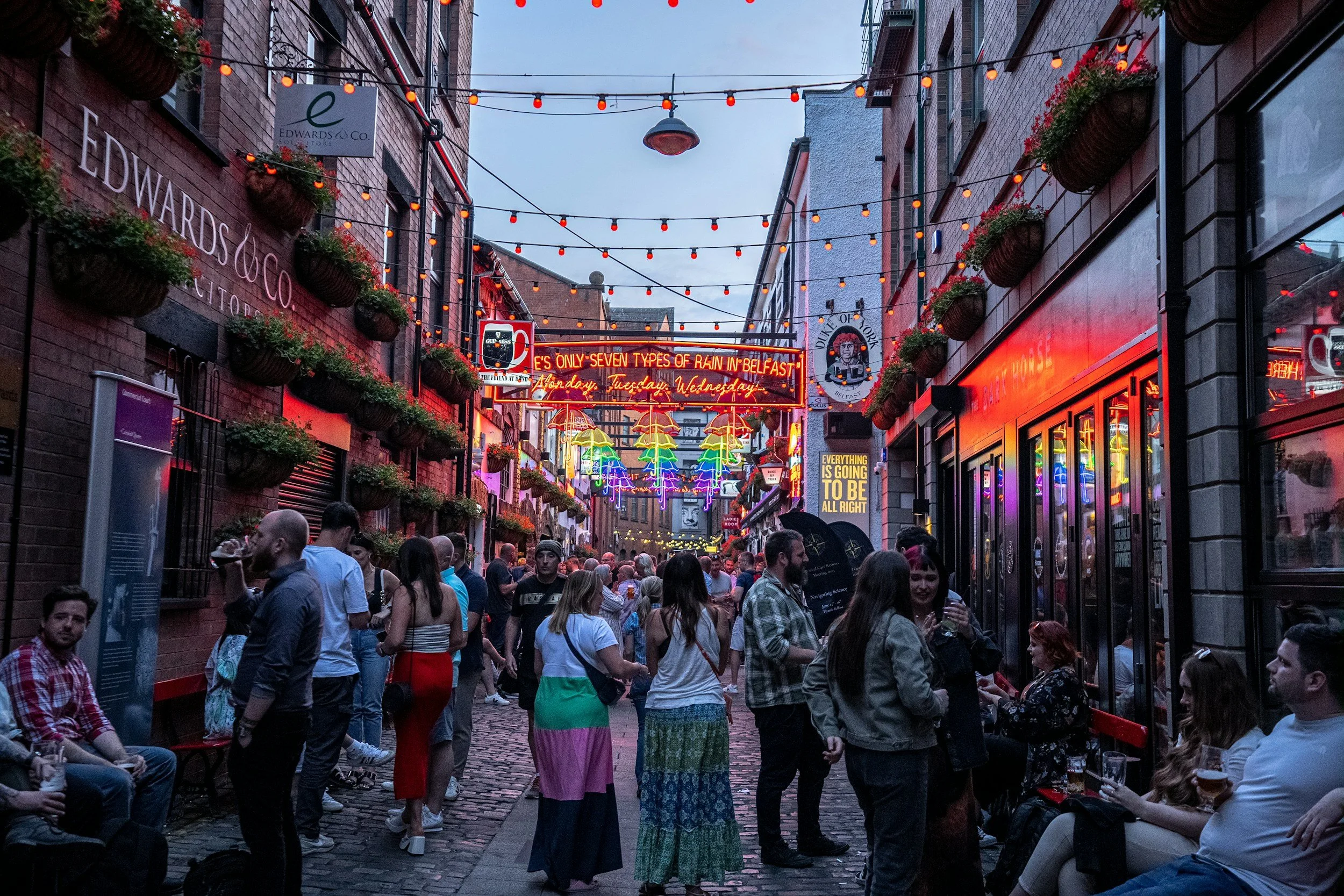
A recent headline in The Irish News caught my attention:
“Belfast hotels already charging more than double for Fleadh 2027 rooms.”
The article found rooms across four hotel chains priced between 43% and 107% higher for Fleadh week 2027 than for the week beforehand.
I can understand why that makes a good headline. If you're a guest looking at a room that's considerably more expensive one week than the next, you're going to question it.
But I think there's some important context missing from the debate.
When 800,000 visitors became 1.6 million
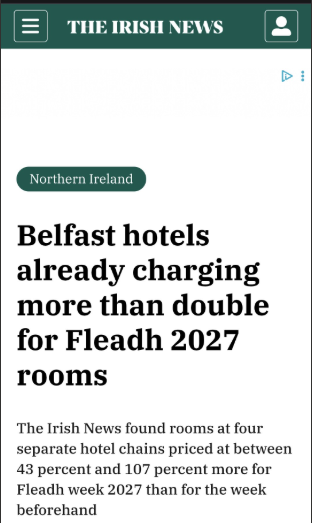
Just two short weeks ago, Belfast hosted what I can only describe as probably one of the best things ever to happen to our city – the Fleadh (pronounced Fla).
For anyone unfamiliar with it, the Fleadh is a week-long celebration of Irish music and dance that moves around Ireland each year. Around 800,000 visitors had been expected in Belfast, but we smashed that figure, with an estimated 1.6 million people visiting over the course of the event.
As someone who is incredibly proud of my home city, it was amazing to see. Belfast was alive with music and our hotels, bars and restaurants were packed. It was joyous to see the city so vibrant and welcoming.
So, when hotels are now setting their rates for 2027, they're doing so knowing exactly what this event can bring.
Does that mean a 107% increase is automatically justified? No. But does it mean a higher rate is automatically unethical? I don't believe that either.
We accept demand-based pricing elsewhere
If you fly to Malaga in the middle of the summer holidays, you expect to pay considerably more than you would on a rainy Sunday in January. We might not like it, but we understand why it happens.
It's supply and demand.
Hotels work on exactly the same principle. There are only so many bedrooms available in Belfast on any given night, and when hundreds of thousands of additional people want to visit at the same time, demand increases while the number of rooms stays the same.
It would actually be rather strange if hotel rates didn't respond.
A £200 room doesn't mean £200 profit
There's also a commercial reality that's easily forgotten when we look at a room rate.
Hotels are increasingly expensive businesses to operate, with rising employment, energy, food, insurance, maintenance and technology costs. Major events also require more people to service that additional demand.
Then take a £200 hotel room. There's VAT to account for and potentially a sizeable commission if it has been booked through an online travel agent. Add housekeeping, laundry, utilities, amenities and perhaps breakfast, followed by all the wider costs of running the hotel, and that £200 reduces pretty quickly.
It's one of the reasons I'll always encourage people to book direct with the hotel whenever possible.
Hotels also need those high-demand weeks. Many operate in highly seasonal markets, and an unsold hotel room can't be put back on the shelf and sold tomorrow. Equally, sell all your rooms too cheaply months in advance and you can't get them back when demand suddenly takes off.
That's why good revenue management is about understanding demand and setting the right price at the right time.
So, how much is too much?
This is where it becomes more nuanced.
I can't say that every hotel in Belfast will get its Fleadh pricing right. Simply doubling a rate because you think someone will be desperate enough to pay it isn't good revenue management, and overpricing can often cause more harm than good.
Guests complain, valued customers don't return and reputations suffer.
But equally, we can't look at a 43%, 70% or 107% increase in isolation and decide whether it's ethical.
Instead, I'd be asking: What is happening to demand? How quickly are rooms selling? What's happening to booking pace? How much availability is left? And what are guests prepared to pay?
That's the context that tells us whether the price is right.
What does demand justify?
After seeing Belfast welcome around 1.6 million visitors this year, I don't think the question is whether hotel rates should increase for the Fleadh in 2027.
Of course they should - but the more pressing question is: by how much?
A 43% increase may be entirely justified at one hotel, while 107% at another may prove too high. We can't know that simply by comparing the rate with the week beforehand.
Good revenue management isn't about putting prices up at every opportunity or squeezing every possible pound out of a guest. It's about understanding what genuine demand supports and having the confidence to price accordingly.
And let's not allow the pricing debate to overshadow what happened in Belfast. Our city was alive with music, our hospitality businesses were bursting at the seams and thousands of people worked incredibly hard behind the scenes to make it happen.
Did every hotel get every pricing decision right? Probably not. But overall, I think our hospitality industry did our city proud.
And if you get the chance to experience the Fleadh in Belfast in 2027, please do.
We can’t wait to welcome you with open arms!
