Revenue management isn’t just pricing anymore (and it hasn’t been for a while)
For a long time, revenue management has been neatly packaged as a pricing function, and to be fair, that’s not an unreasonable place to start. The move from spreadsheets to automated pricing has been a genuinely important shift for the industry, bringing efficiency, reducing manual effort, and helping many hotels feel more in control of their day-to-day decisions.
For a lot of teams, that alone has delivered real value.
But if we are being honest, pricing has always only been part of the job - and increasingly, it’s the smaller part.
The moment pricing stops being the main question
No one is suggesting that setting the right rate isn’t important. But when you listen to the conversations revenue leaders are actually having, they rarely begin with “what price should we set today?”
They’re far more likely to focus on understanding demand, questioning whether the business is relying too heavily on certain segments, and thinking ahead to how current trends might shape performance over the coming months. There’s a constant balancing act between occupancy, rate, and long-term positioning, and those trade-offs don’t lend themselves to simple pricing decisions.
And at that point, the conversation has already moved on – its no longer about rate and pricing, it’s about strategy.
Demand doesn’t sit in a silo - and neither should revenue management
Over the past few years, revenue management has expanded beyond its traditional boundaries. It’s no longer sitting in a silo, reacting to demand signals and adjusting rates in isolation. Instead, it’s becoming far more central to how hotels think about performance as a whole.
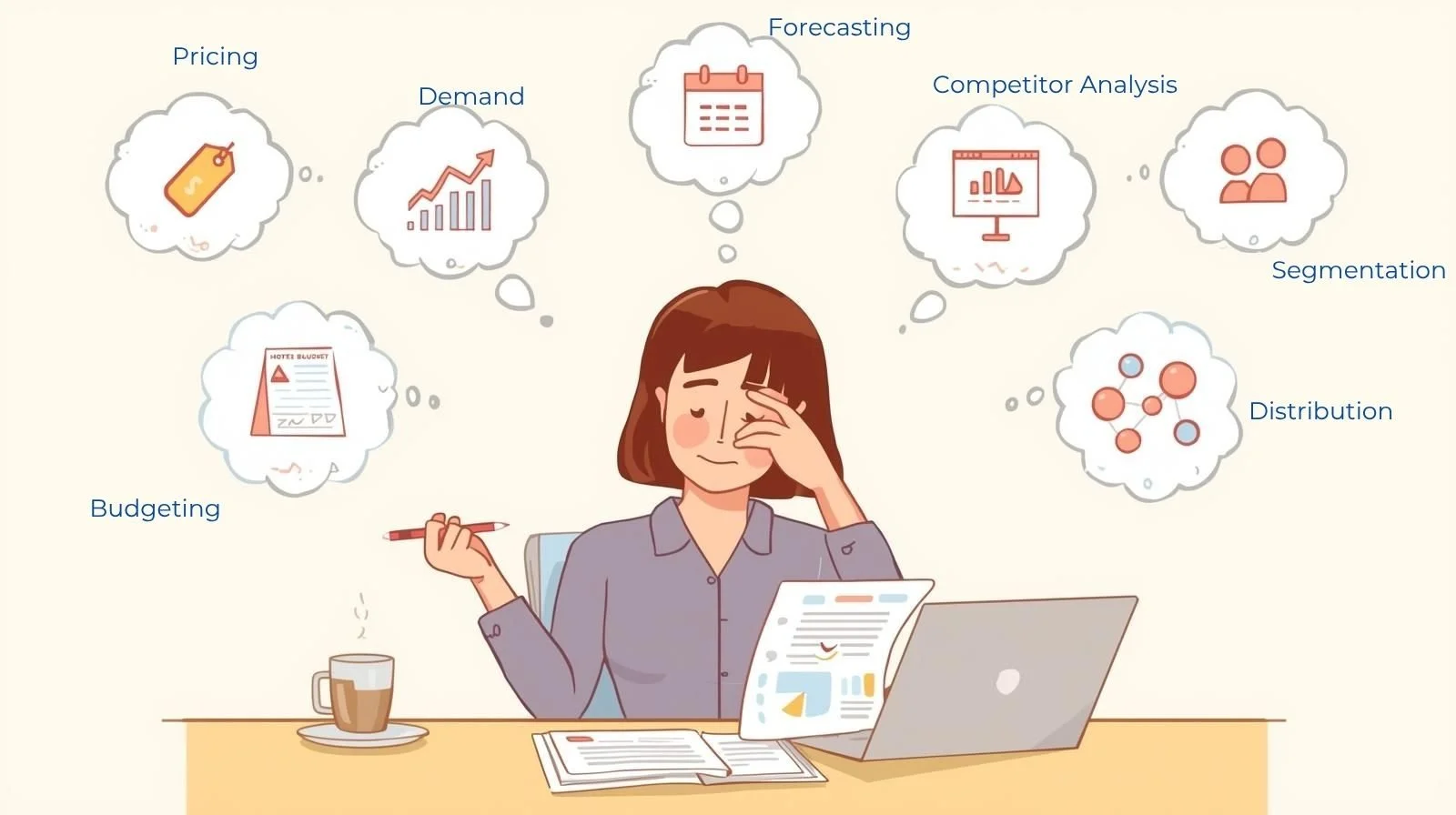
Revenue leaders are now involved in forecasting, budgeting, shaping business mix, aligning with marketing activity, and influencing sales strategy. In many cases, they’re the ones connecting the dots across the commercial function, bringing together different strands of insight into a clearer picture of where the business is heading.
And when you step back, that evolution makes complete sense, because demand itself doesn’t sit neatly within one department — so why should revenue management?
Whats also become apparent that as the role of revenue management has evolved, so are the tools needed to support it. They need to reflect the new reality. And for me, this is where things start to get interesting.
A lot of technology in this space still focuses heavily on automating pricing decisions, and that absolutely has its place. For many hotels, it provides a strong foundation and removes a lot of the manual burden that used to slow teams down.
But once that foundation is in place, the questions don’t stop. In fact, they become more nuanced. The conversation naturally shifts from “what should we price?” to “why is this happening, and what should we do about it?”
This is where the magic happens – when the focus shifts from automating pricing to building on it – digging deeper, discovering the how, why, where and when and helping hotels move from making efficient decisions to making confident, well-informed ones.
Because most revenue teams want to understand what’s really driving the decision
One of the things we hear time and time again from revenue teams is that a recommendation on its own rarely tells the full story. It might point you in a direction, but without understanding what’s driving it, it can be difficult to act with real confidence.
What people really want to know is what sits behind the suggestion - which signals are influencing the outcome, how different factors are being weighted, and what might change if they took a different approach. Because ultimately, revenue management isn’t about following instructions, it’s about making informed decisions.
That’s where explainable AI starts to matter. Not as a buzzword, but as something genuinely useful, bringing transparency into the process so revenue leaders can see the thinking, challenge it where needed, and stay closely connected to the decisions they’re making.
When people understand why decisions are being made, they’re far more likely to engage with them. It builds confidence across the team, encourages better conversations, and creates a sense of shared ownership over performance.
Instead of revenue management feeling like something that’s blindly “done to” the business, it becomes something the business is actively part of. People start to buy into the strategy, not just follow it and that’s where you begin to see a real shift, not just in performance, but in culture as well. The impact can be quite profound - I know, I’ve seen it!
.
Why reacting isn’t enough anymore
Hospitality has always been dynamic, but recent years have made that even more apparent. Demand doesn’t always behave predictably, and external factors can shift performance quickly.
In that kind of environment, the ability to explore different scenarios becomes incredibly powerful. Scenario modelling and budget modelling allow hotels to test ideas, understand potential outcomes, and make decisions with greater clarity … not because the future is certain, but because they’re better prepared for it.
Strong commercial performance rarely comes from one function operating in isolation. It comes from alignment across the business, where pricing, sales, marketing, and distribution are all working from the same understanding of demand and the same strategic priorities.
That’s when revenue management stops being a function and starts becoming a driver of performance.
Pricing still matters, but it’s no longer the defining factor
What increasingly sets hotels apart is how well they understand their demand, how clearly they plan, and how effectively they align their commercial decisions - because over time, it’s those decisions that shape performance far more than price alone.
And just as importantly, it’s how well those decisions are understood across the business.
Because when teams understand the thinking behind the strategy, they’re far more likely to engage with it, challenge it, and ultimately take ownership of it. That’s when revenue management stops being a function that sits with one person or one system, and starts becoming something that the whole business is invested in.
And that’s where the real shift happens - not just in performance, but in how the business thinks, makes decisions, and ultimately drives its future.
If this shift resonates, it might be time to start thinking beyond pricing alone.
The opportunity now is in connecting the dots - understanding demand more deeply, aligning your commercial strategy, and making decisions with greater confidence.
This is exactly where we’re focused at Right Revenue. We would love to hear from you if you think we can support your commercial strategy. Contact us at ask@rightrevenue.co.uk
