
The Cancellation KPIs Every Revenue Manager Needs
Cancellations are part of hotel life.
Whether it's a guest changing their plans, a corporate traveller postponing a meeting or someone simply finding a better deal elsewhere, every hotel experiences cancellations. The goal isn't to eliminate them altogether - it's to understand them.
Yet many hotels still look at cancellations as one headline number.
"We had 15% cancellations last month”…and while that's useful, it only tells part of the story.
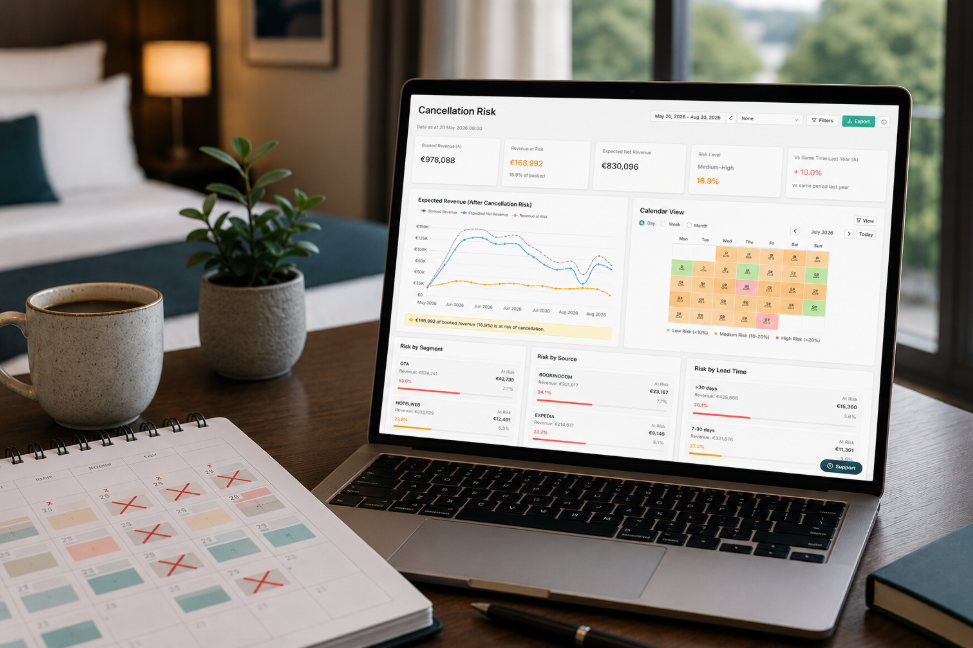
To really understand how cancellations affect your business, you need to dig deeper. Different markets, booking channels and lead times all behave differently, and understanding those patterns allows you to forecast more accurately, price more confidently and react before cancellations become a problem.
Start with Your Overall Cancellation Rate
Your overall cancellation rate gives you a useful benchmark.
It helps answer questions such as:
Is our cancellation rate increasing?
How does this compare to the same period last year?
Are cancellations becoming more frequent?
However, this should only ever be the starting point. On its own, an overall percentage can hide some significant trends.
Measure Cancellation Rate by Market Segment
One of the most valuable metrics is cancellation rate by market segment.
For example:
Corporate
Leisure
Groups
Airline
Wholesale
Long stay
Some segments naturally have higher cancellation rates than others.
If your leisure guests regularly cancel at 25%, but your corporate guests only cancel at 5%, you'll forecast those segments very differently.
Without understanding these differences, it's easy to either overestimate demand or become unnecessarily cautious.
Understand Which Booking Channels Cancel Most
Not every booking channel behaves the same.
Track cancellation rates across:
Direct website
Online Travel Agents (OTAs)
GDS
Call centre
Travel agents
Wholesalers
You may discover that one channel consistently produces bookings that rarely show up, while another delivers much more reliable business.
That insight becomes incredibly valuable when making pricing and distribution decisions.
Track Cancellation Rates by Lead Time
This is one of the most revealing metrics of all.
Ask yourself:
Which bookings made 90 days before arrival eventually cancel?
What happens to bookings made 30 days out?
How reliable are bookings made within seven days of arrival?
Understanding how cancellation behaviour changes over time helps improve your forecast at every stage of the booking window.
For example, if half of your bookings made more than three months in advance typically cancel before arrival, you'll naturally treat that demand differently from bookings made just a few days before check-in.
Monitor Cancellation Trends by Arrival Date
Looking at when cancellations happen can reveal patterns you might otherwise miss.
Are weekends more vulnerable than weekdays? Do school holidays behave differently? Are certain months consistently more volatile?
These trends can influence pricing decisions, inventory strategy and even staffing levels.
Measure the Financial Impact
Not every cancellation carries the same value.
Losing one premium suite booking during a busy weekend is very different from losing a discounted room on a quiet Tuesday.
Understanding the revenue value of cancellations - not just the number of bookings- helps you focus your attention where it matters most.
Sometimes a small number of cancellations can have a much bigger impact than a large volume of lower-value bookings.
Watch How Cancellation Patterns Change
Cancellation behaviour isn't fixed.
Economic conditions, travel trends, airline disruption, booking flexibility and guest confidence all influence how people book and cancel. That's why it's important to track trends over time rather than relying on historic assumptions.
A cancellation rate that was perfectly normal two years ago may no longer reflect today's booking behaviour.
Turn Data into Better Decisions
The purpose of measuring cancellations isn't simply to create another report - it's about making better commercial decisions.
When you understand where cancellations are coming from, which bookings are most reliable and how behaviour changes throughout the booking window, you can:
Produce more accurate forecasts.
Make pricing decisions with greater confidence.
Reduce unexpected occupancy gaps.
Better manage overbooking levels.
Respond earlier when demand starts to soften.
Ultimately, cancellation data gives you a clearer picture of the business you're likely to welcome through the door -not just the business that's currently sitting on the books.
Experience has shown that the hotels that perform best don't just measure how many bookings they have - they understand how many of those bookings are actually likely to stay.
***Want to understand your cancellations in more detail?***
Right Revenue's new Risk of Cancellation Report gives you a clear view of where cancellations are likely to happen, when they're expected and how they'll impact your revenue-so you can make more confident commercial decisions. Get in touch at ask@rightrevenue.co.uk to find out more.
